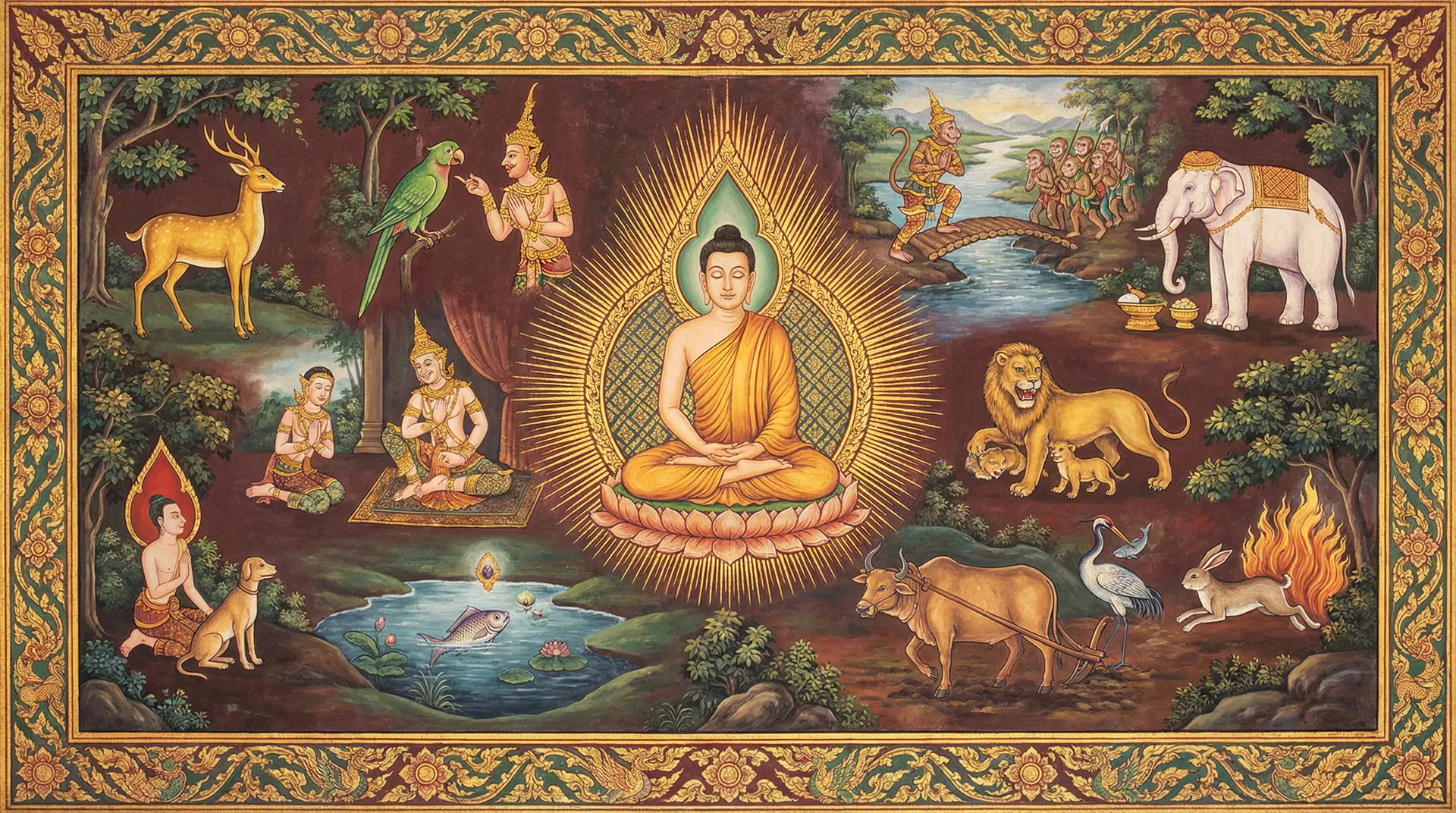
Sama Jataka
The Bodhisatta's Compassion for All Beings
In the lush, verdant forests of the Himalayas, lived a wise and virtuous hermit. This hermit, who was none other than the Bodhisatta in a past life, had dedicated his existence to the practice of compassion and the pursuit of spiritual wisdom. He lived a life of austerity, renouncing all worldly pleasures, his only companions the birds, the beasts, and the rustling leaves of the ancient trees. His heart was filled with an immeasurable love for all living creatures, seeing them as his own kin.
The Bodhisatta hermit lived with his two devoted children, a son named Sama and a daughter named Pattara. They lived a simple life, free from the complexities and cruelties of the human world. Sama, in particular, possessed a gentle spirit and a deep connection with the forest creatures. He would often spend his days tending to injured animals, feeding hungry birds, and ensuring that no creature suffered needlessly.
One day, a terrible conflict erupted between the kingdoms of Kasi and Kosala. The kings, blinded by pride and ambition, waged a brutal war, laying waste to the land and causing immense suffering to the innocent.
During this period of widespread violence, a hunter from the kingdom of Kasi, named Magha, was dispatched on a mission to kill the king of Kosala. However, Magha was a cruel and reckless man, his heart devoid of compassion. While tracking his target near the Himalayan foothills, he stumbled upon the hermitage where the Bodhisatta hermit and his children lived.
Seeing the hermit meditating peacefully, Magha, in his misguided zeal and thirst for bloodshed, mistook him for an enemy spy or a sorcerer who might be hindering the war effort. Without a moment's hesitation, he drew his bow and loosed an arrow, striking the Bodhisatta hermit directly in the chest. The Bodhisatta, in his final moments, did not cry out in anger or pain towards his attacker. Instead, his last thoughts were of his children, and his last breath was a silent prayer for the well-being of all beings, including the hunter.
Sama and Pattara rushed to their father's side, their hearts filled with grief and horror. They saw their beloved father, the embodiment of kindness, lying mortally wounded. Pattara, overcome with sorrow, began to weep uncontrollably. Sama, though heartbroken, remembered his father's teachings of compassion and equanimity. He gently comforted his sister, his own tears flowing silently.
Meanwhile, Magha, the hunter, was filled with a sudden, overwhelming sense of dread and remorse. As he looked at the dying hermit, and then at the sorrowful faces of his children, he realized the enormity of his crime. He had not only killed a virtuous man but had inflicted immense suffering on innocent children. He confessed his deed and begged for forgiveness, his voice trembling with shame.
The Bodhisatta hermit, with his dying breath, looked at Magha. 'I forgive you,' he whispered, his voice weak. 'May you find peace and learn the wisdom of compassion. Do not let this act be a stain upon your soul forever. Instead, let it be a lesson.' He then turned to his children and, with his last gaze, imparted his final blessings, urging them to continue the path of righteousness and kindness.
After the hermit's passing, Sama and Pattara were left alone in the wilderness. Their grief was profound, but they held onto their father's teachings. They continued to live in the hermitage, their compassion unwavering. They cared for the forest creatures, their father's legacy living on through their actions.
Sama, now the sole protector of his sister, was deeply troubled by the injustice and violence of the world that had taken their father. He decided to travel to the capital city of Varanasi to plead for justice and to remind the kings of their duty to protect all beings, not to harm them. He journeyed with a heavy heart, carrying the memory of his father's love and his father's forgiveness.
Upon reaching the city, Sama, a youth of remarkable purity and earnestness, sought an audience with the kings of Kasi and Kosala. He stood before them, a humble figure against the backdrop of royal power, and spoke with the voice of his father, echoing the teachings of compassion. He recounted the tragedy that had befallen his family, not with blame, but with a plea for understanding and a call for peace.
His sincerity and the profound love that emanated from him touched the hearts of the kings. They were humbled by his youthful wisdom and the echo of the virtuous hermit they had unknowingly wronged. They realized the futility of their war and the suffering it caused. Moved by Sama's plea and the memory of the hermit's forgiveness, they agreed to end their conflict and live in peace, recognizing the importance of compassion for all beings.
The story of Sama, the hermit's son, and his unwavering compassion became a legend, a testament to the power of forgiveness and the enduring strength of love, even in the face of profound loss and violence. It reinforced the understanding that compassion is not merely an emotion, but a guiding principle that can bring peace and reconciliation to a troubled world.
— In-Article Ad —
💡Moral of the Story
The highest form of compassion includes forgiveness, even towards those who have caused immense suffering. True peace and reconciliation can be achieved when individuals and rulers embrace righteousness, kindness, and the understanding that all beings deserve protection and love.
Perfection: Compassion (Karuna)
— Ad Space (728x90) —
More Jataka Tales You May Enjoy
 328Catukkanipāta
The Wise Heron Jataka
The Wise Heron Jataka In a serene lake, fringed with lotus flowers and reeds, lived a wise old heron...
💡 Calmness, observation, and the ability to discern truth are essential tools to overcome fear and defeat deceit.
 183Dukanipāta
Muḷapariyāya Jātaka
The Tale of the Root of All EvilIn the ancient and prosperous city of Varanasi, ruled a king named B...
💡 The root of all suffering and evil lies within the human mind, stemming from craving, attachment, and ignorance. True peace is found by understanding and overcoming these internal afflictions.
 111Ekanipāta
Bhūridatta Jātaka
Bhūridatta Jātaka Long ago, in the mystical kingdom of Indapatta, there lived a wise and benevolent ...
💡 True strength lies not in subjugating others, but in compassion and self-sacrifice. Wisdom and kindness can transform even the most hardened hearts.
135EkanipātaVessantara Jataka
The Tale of the Generous Prince Vessantara In the kingdom of Siwi, ruled a wise and benevolent king....
💡 True generosity extends beyond material possessions; it involves the willingness to sacrifice even the most cherished aspects of one's life for the sake of others and one's principles.
107EkanipātaMahāsuvanna Jataka
The Tale of the Golden Swan and the Covetous Merchant In the vibrant city of Benares, nestled beside...
💡 Greed leads to destruction and disgrace. True value is found in honesty and integrity, not in material possessions.
53EkanipātaThe Bodhisatta as the Clever Swan
The Bodhisatta as the Clever SwanOn the shores of a crystal-clear lake, where the water mirrored the...
💡 Intelligence and foresight are more powerful than brute force, and can protect the innocent without resorting to violence.
— Multiplex Ad —